Resistojet and plasma brake from Aurora Propulsion launched
SpaceX’s Transporter-15 flight carried to space up to six Finnish satellites (five ICEYE SAR satellites and Foresail-1p from Aalto University), as well as other Finnish technology: small thrusters and a plasma brake from Aurora Propulsion Technologies Oy.
The WISDOM mission (Wise Integration of Satellites PNT tracking Data using OWL for collision avoidance Management) is a cooperative mission of the Hungarian CubeSat platform provider C3S LLC, Aurora Propulsion Technologies, and the European Space Agency.
The goal is to gather information about and demonstrate technologies for small-satellite collision avoidance, autonomous operation, and re-entry.
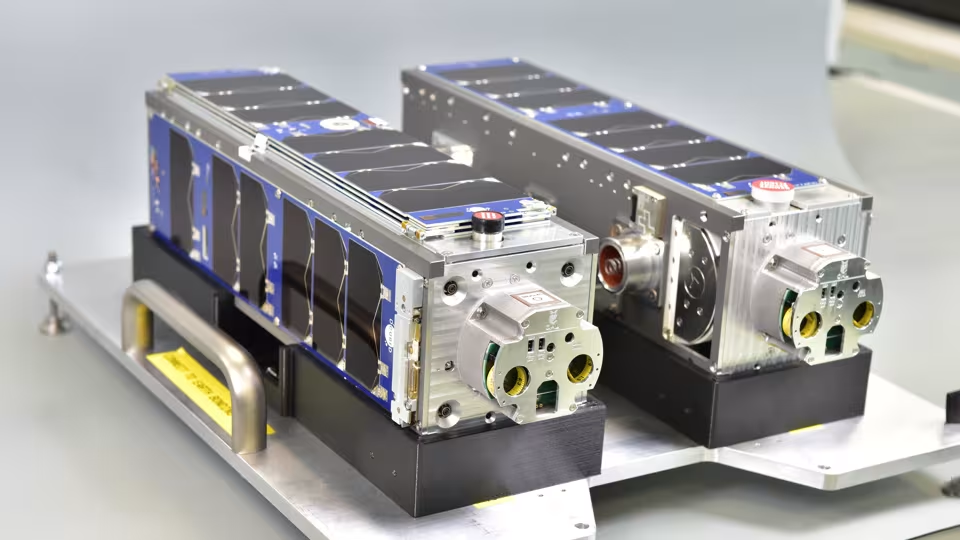
The mission consists of a 6-unit CubeSat that separates into two 3-unit CubeSats in orbit. One of these is equipped with four of Aurora Propulsion’s Aurora ARM-C thruster modules; the other with a PB-S-TC plasma brake module.
The plasma brake is a superior micro-tether-based deorbiting system that enables compliance with satellite deorbiting regulations, using a uniquely compact and light module. The tether weighs as little as 36 grams per kilometre. The plasma brake can be configured to enable deorbiting even if the satellite fails.
Aurora’s plasma brake systems are designed to be scalable for spacecraft in the 2–1000 kg range. The system on the WISDOM satellite is a module adapted for CubeSats.
Aurora Resistojet Modules (the ARM series) are fast-response, water-based micro-thrusters that provide a throttleable nominal thrust of 1 mN per thruster. Thrust can be controlled from single micro-Newtons up to 5 milli-Newtons, making the thruster optimal for collision avoidance, formation flying, and proximity-operations missions.