
Happy 30th launch anniversary, SOHO!
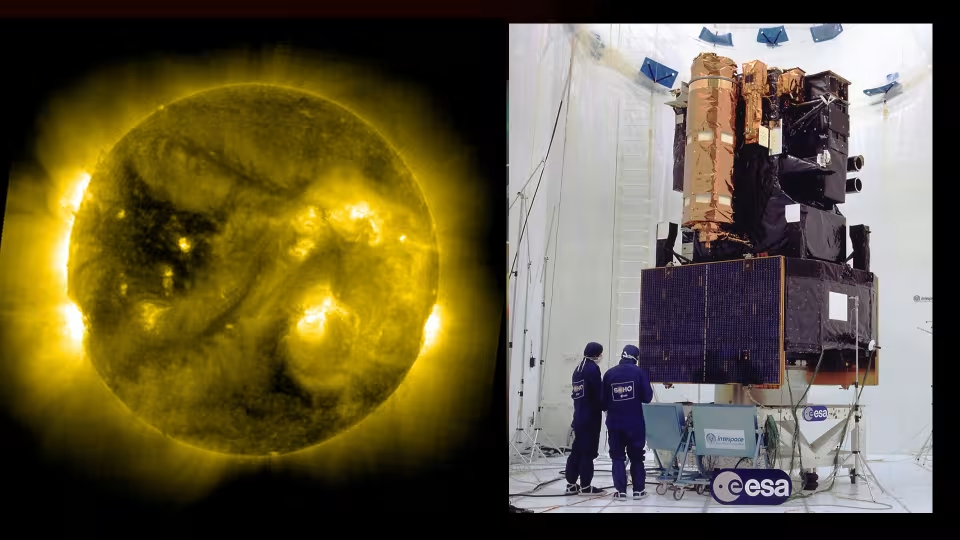
Although our project looks to the future and above all from the perspective of the so-called New Space, it’s sometimes worth remembering traditional space technology and the past - such as the Sun-observing SOHO spacecraft.
SOHO, or the Solar and Heliospheric Observatory, is a joint project between the European Space Agency and NASA, in which Europe was mainly responsible for building the spacecraft and NASA paid for its launch into space. The launch took place on 2 December 1995, exactly three decades ago today.
According to the original plan, SOHO was supposed to operate only until 1998, but thanks to its excellent condition and outstanding scientific results, ESA and NASA decided to extend the mission first until 2003 and then continuously ever since. Even today, the spacecraft still sends its daily images and near-real-time measurements.
SOHO is located 1.5 million kilometres from Earth at the so-called Lagrange point L1 between Earth and the Sun, where it can observe the Sun uninterrupted 24/7.
For Finland, SOHO was and remains extremely important, because it was one of the very first ESA projects in which Finland, having just joined the agency, participated. No fewer than two of the spacecraft’s total of 12 scientific instruments were built in Finland.
SWAN (Solar Wind ANisotropies) is an instrument built in cooperation between the Finnish Meteorological Institute and the French Service d’Aéronomie. It studies slow variations in the particle flux coming from the Sun as well as the properties of gas flowing in from interstellar space. For example, by measuring the Sun’s Lyman-alpha radiation reflected by hydrogen atoms in the Solar System, it is possible to calculate the density of hydrogen gas and the velocity of atoms in interstellar space.
SWAN is the only instrument on SOHO that does not observe the Sun alone; instead, it scans the entire sky around the spacecraft. It can even, in a sense, “look behind” the Sun.
Because SWAN can detect any object containing hydrogen gas, it has also been used to observe the gas envelopes (comas) of comets. In this way, new comets have been discovered and, for example, the properties of the gas envelopes of comets Hyakutake and Hale-Bopp have been studied.
In addition to the Finnish Meteorological Institute, VTT Technical Research Centre of Finland and the former Finnyards also participated in building the instrument in Finland.
ERNE (Energetic and Relativistic Nuclei and Electron experiment) is the second Finnish-made instrument. Built at the University of Turku, it is a detector of high-energy charged particles that studies particles coming from the Sun. It has revealed a great deal of new information about how particles accelerate and behave in the solar wind – the constant outward-flowing stream of particles from the Sun. ERNE also enables real-time monitoring of solar eruptions.
Data from the ERNE instrument can be viewed on the University of Turku’s website.
Although SOHO has worked exceptionally well and proved remarkably resilient, its mission has come close to ending a couple of times.In 1998, contact with the spacecraft was lost, but after several months of intensive recovery work it was successfully restored to operation. In addition, several of the spacecraft’s attitude-control gyroscopes have failed, yet the probe has been kept operational.