
Waiting for stormy space weather
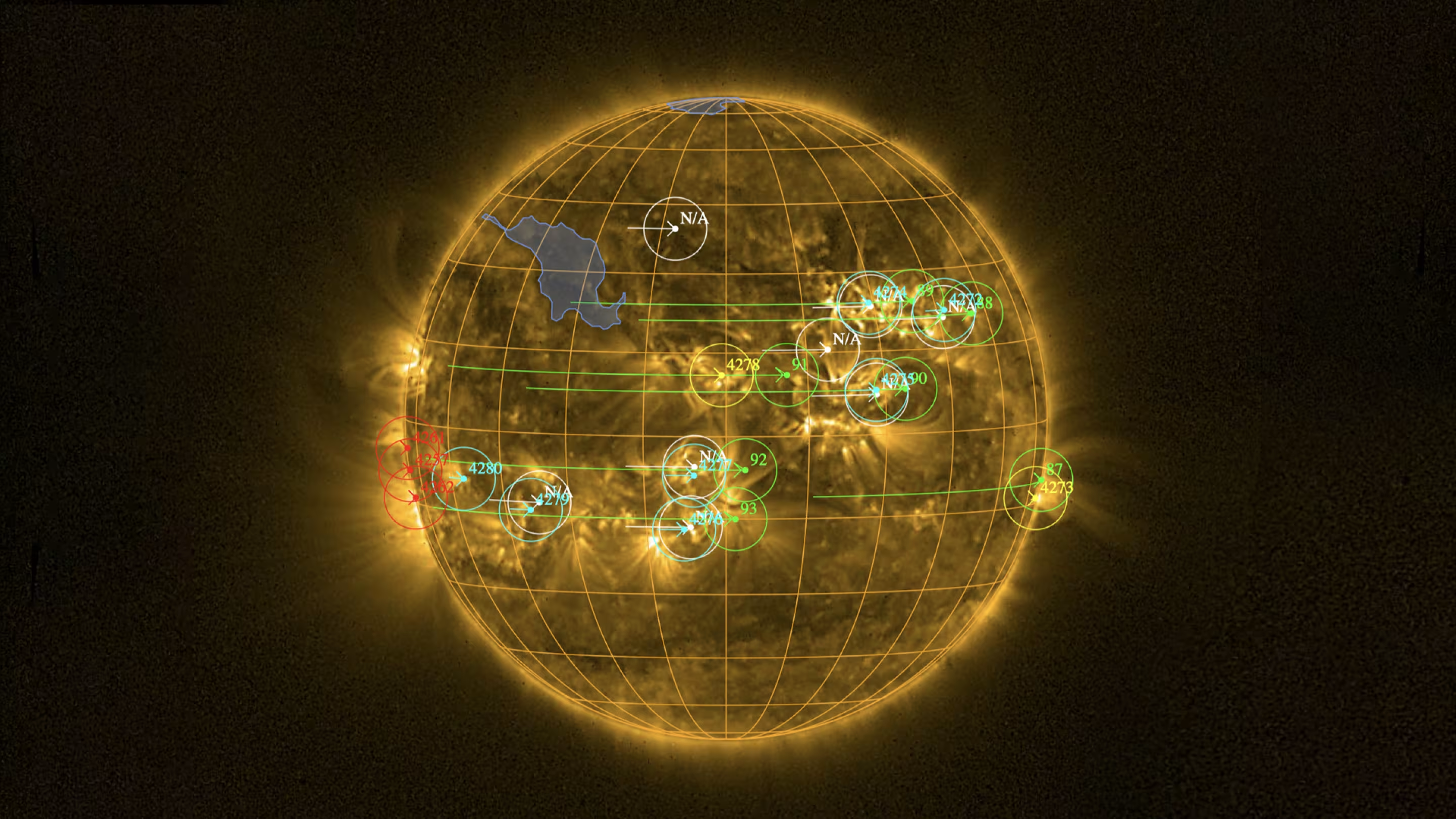
The Sun produced major coronal mass ejections over the weekend and yesterday, and today, Tuesday, it unleashed the most powerful flare of this sunspot cycle so far from its surface, with a strength of X5.16.
Previous eruptions triggered coronal mass ejections, which are likely to hit Earth this Tuesday. These will cause geomagnetic disturbances and auroras.If the two clouds of charged particles from these earlier eruptions merge before hitting Earth, the result could be a very powerful space storm. This would affect telecommunications, the accuracy of satellite navigation, and could cause issues for satellites.
A similar, slightly milder event occurred last April, resulting in a strong G4-class storm. At that time, auroras were seen even in southern Europe, but fortunately, major damage was avoided.
Now, the Transporter-15 mission, carrying the Finnish Foresail-1p satellite and about a hundred other satellites, is scheduled to launch during this space storm. It’s possible that the launch will be postponed, as a strong radiation environment is not ideal for satellites just entering space.
The SpacEconomy project involves several universities researching space weather and its effects. Preparedness for space storms, along with the required technology, are part of our project as well.
One of the units in the recently concluded Academy of Finland’s Centre of Excellence period was the Centre of Excellence in Sustainable Space Science and Technology, which included, among others, the University of Helsinki, Aalto University, and the University of Turku. These same institutions are also involved in the newly funded Centre of Excellence in Space Resilience.
The European Space Agency’s Space Weather Office and the Finnish Meteorological Institute’s space weather service are monitoring the situation.
The most up-to-date information can be found on ESA SWE’s Bluesky account and the LinkedIn posts of Juha-Pekka Luntama, the head of the space weather office.