
SpaceX has finally a credible competitor – Blue Origin succeeds in rocket recovery
SpaceX, founded by Elon Musk, has risen in 20 years to become the world’s largest space operator, holding a near-monopoly position as the Western world’s rocket launcher for several years.
Now the situation is changing: Blue Origin, founded by Jeff Bezos, known for Amazon, succeeded on the evening of 13 November Finnish time, in bringing a rocket stage back down for the first time, potentially for reuse.
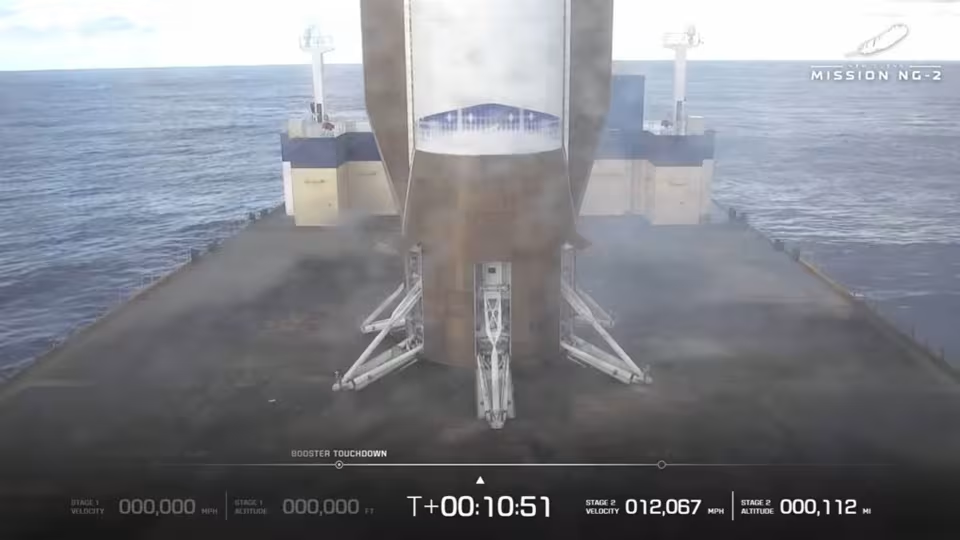
The company’s New Glenn rocket successfully launched two NASA probes toward Mars, and the rocket’s first stage landed on a platform in the Atlantic.
The principle is the same as with SpaceX’s Falcon 9 rockets: the first stage is the most expensive, heaviest, and most complex part of the launch vehicle, so reusing it results in significant cost savings.
Blue Origin has been using the smaller, fully reusable New Shepard rocket for space tourism flights for ten years. These flights just barely reach space (officially, the boundary is 100 kilometers), but the rocket and the passenger capsule return immediately.
Sending a payload into orbit requires a much larger and more powerful rocket, but with New Shepard, Blue Origin has gained significant experience in launching and landing rockets.New Glenn is significantly larger. It is also bigger than Falcon 9 – roughly the average of Falcon 9 and SpaceX’s new Starship.
Falcon 9 is about 70 meters tall and 3.7 meters in diameter, New Glenn is 98 meters and 7 meters, and Starship is 120 meters and 9 meters in diameter.
All have a large first stage and a second stage, which in Falcon 9 and New Glenn is (at least for now) expendable.
Falcon 9 can lift 23 tons to low Earth orbit (or 27 tons when the first stage is not reused). New Glenn can launch 45 tons, and Starship 100–150 tons. To geostationary transfer orbit, Falcon 9 can deliver 8.3 tons (or 9.2 tons), New Glenn 13.6 tons, and Starship 21 tons.
When the destination is the Moon, Falcon 9 can send about 4 tons, New Glenn 7 tons, and Starship is a different case, as by refueling the upper stage in space, it can deliver about 100 tons.
Falcon 9 uses nine SpaceX Merlin 1D engines powered by kerosene and liquid oxygen, while New Glenn has seven more powerful Blue Origin BE-4 engines, which, like Starship, use liquid methane and oxygen. Starship has 33 Raptor engines.
Fully fueled and ready for launch, Falcon 9’s mass is about 550 tons, New Glenn’s is 1,200 tons, and Starship’s is 5,000 tons.
Blue Origin plans to use its rocket for Amazon’s Kuiper telecommunications satellite network, mirroring SpaceX’s approach. Kuiper is set to become a competitor to SpaceX’s Starlink.
According to the current plan, the New Glenn first stage that landed will also fly the next mission early next year, carrying Kuiper satellites.
For now, Blue Origin does not plan to launch rockets as frequently as SpaceX. Next year, the goal is to conduct ten launches, and in 2027, perhaps 12. After that, the target is over 20 launches per year.