All-time high funding secured for the European Space Agency
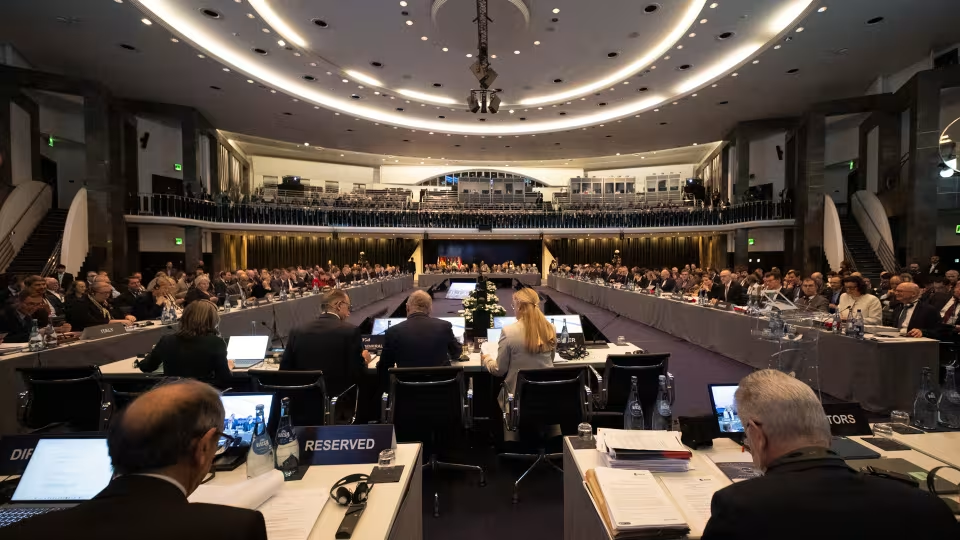
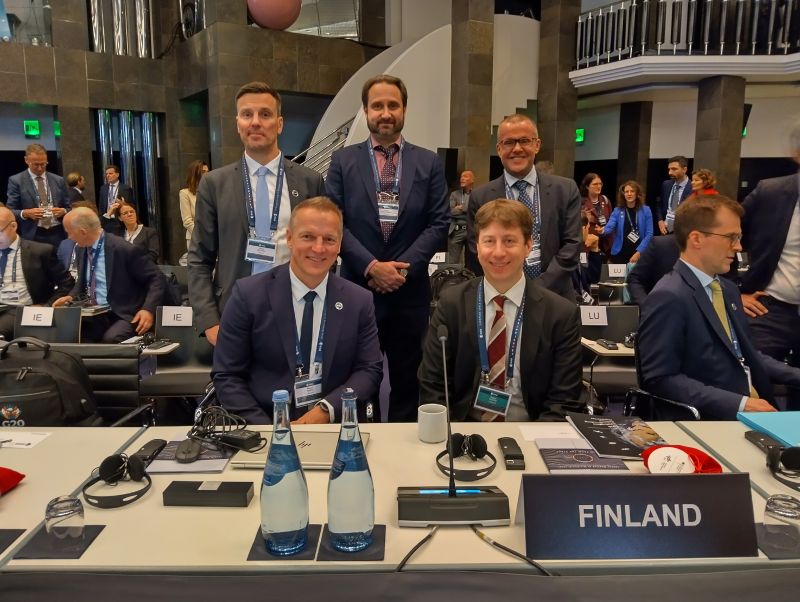
The European Space Agency’s (ESA) Ministerial Council is the organisation’s highest decision-making body and usually meets every 2–3 years. As the name suggests, it is attended by the ministers responsible for space activities in ESA member states (for example, Finland’s Minister of Economic Affairs Sakari Puisto) or other high-level representatives.
At the meeting, the ESA Director General presents the agency’s priorities for the coming decade. The national delegations discuss these priorities and propose possible changes to the overall direction and budget. Countries announce how much they are prepared to invest in ESA’s activities and individual programmes over the coming years, decide on new programmes, and discuss how to ensure that industrial contracts are returned to member states as fairly as possible in proportion to their financial contributions (the principle known as “geo-return”).
The previous Ministerial Council was held in Paris in 2022, where it was decided to increase ESA’s budget and expand its activities. The same trend continued this time: the approved €22.1 billion is the largest budget in ESA’s history. This is for a period of three years.
The amount is 32% higher (17% higher when adjusted for inflation) than the previous period’s budget.Finland’s contribution will rise from €147 million to €233 million. Estonia is doubling its share from €25 million to €58 million. Poland’s contribution will increase from €194 million to €731 million. The biggest relative increase comes from associate member Canada, which is raising its participation from €81 million to €408 million.
Particularly large funding increases were directed towards programmes related to European crisis resilience, adaptability and security – such as Earth observation, satellite navigation and telecommunications.
New rockets and so-called “New Space” initiatives also received substantially more funding from member states.
The strong growth in funding is driven by the geopolitical situation and the desire to increase Europe’s share of global space activities. At present, Europe accounts for only about 11% of worldwide space activity – significantly less than Europe’s overall global economic and political weight. Cooperation with the EU, member states and international partners is also becoming increasingly important.
The content of the upcoming programme period ahead is built around the ESA 2040 strategy published this year. Its central goal is to respond to geopolitical challenges, climate change, the growth of the private sector, and the strengthening of Europe’s independence in space.
The strategy has five key focus areas:
1. Protect our planet and climate
Monitoring Earth and protecting Earth’s atmosphere, oceans and ecosystems; combating climate change, preserving biodiversity and managing environmental risks. This includes the Digital Twin Earth, space debris reduction and space situational awareness (which covers, among other things, the study of near-Earth asteroids and space weather monitoring).
In this area, ministers approved funding for three interesting new probes:
- Ramses will be built quickly based on the Hera mission and sent on a fast-track schedule to study the asteroid Apophis, which will pass very close to Earth in 2029.
- Vigil is a space-weather monitoring probe.
- Rise will test in-orbit servicing technologies that can extend satellite lifetimes and thus reduce space debris.
ESA will also begin development of the second generation of Sentinel-2 and Sentinel-3 satellites (optical Earth-observation satellites belonging to the Copernicus programme).ESA and Norway agreed to jointly investigate the possibility of establishing an ESA Arctic Space Centre in Tromsø focused on observation of the northern regions. Tromsø already hosts the ground station for ESA’s experimental Arctic Weather Satellite; based on that satellite, ESA and EUMETSAT are now preparing the EPS-Sterna constellation for Arctic weather monitoring.
2. Explore and discover
ESA is already the world’s leading space-science organisation, and the real-terms 3.5% increase in the science programme will strengthen this position further. The Ministerial Council gave the green light to the gravitational-wave observatory LISA and to the next-generation X-ray telescope NewAthena.
The most ambitious project presented was a mission to Saturn’s moon Enceladus; no final go-ahead was given yet, but preparatory work and required technology development will begin.
The Rosalind Franklin Mars rover will launch in 2028, and the Argonaut lunar lander will be realised.European astronauts will continue visiting the International Space Station until 2030, when the ageing station is planned to be de-orbited. The next long-duration ISS astronaut will be French astronaut Sophie Adenot, the first from ESA’s 2022 astronaut class to fly. Her six-month mission begins next spring.
The meeting also decided to continue ESA’s participation in NASA’s Artemis programme and the Lunar Gateway station. Although NASA’s plans still contain uncertainty, the already-agreed European contributions – flights around the Moon, to the lunar surface and to Gateway – will proceed. European astronauts will fly on these missions: first a German, then a French and an Italian astronaut.
It was also decided to continue development of a European cargo vehicle that can both deliver supplies to a future space station and return cargo to Earth. A crewed version of the same vehicle is technically possible, but that decision will be taken later – possibly already at the next Ministerial Council in 2028.
3. Strengthen Europe’s independence and resilience
The aim is to guarantee Europe’s independent access to space and the ability to operate in space under all circumstances.
In addition to the Ariane 6 and Vega-C launchers that are gradually entering routine service, ESA will support the development of new commercially oriented small launchers through the European Launcher Challenge.
A new dimension in ESA’s activities is the cautious move into dual-use (civil-military) applications. In practice this means “non-aggressive” defence and security uses, which have not previously been part of ESA’s purely civilian mandate. The EU-funded Copernicus Earth-observation satellites and Galileo navigation system Galileo have already supported governmental/authority use (including by armed forces), but now the step toward the military domain is clearer. The spirit of the times is very visible here.
The new European Resilience from Space (ERS) programme will collect imagery of Earth’s surface from various sources and share it among member states. Related to this is the new low-Earth-orbit navigation constellation Celeste (LEO-PNT), which will complement Galileo.
ESA signed an agreement with Poland to jointly study the possibility of establishing a dual-use research centre in Poland.
4. Boost European growth and competitiveness
One of ESA’s core tasks has always been to support European space industry in various ways, but in the future space innovation will be approached even more strongly as an engine of economic growth. So-called New Space and the large-scale commercial exploitation of space applications will receive more than €3.6 billion in support.
Also essential is the expansion and development of European space technology markets and increasing self-sufficiency.In this category is the decision to build the SAGA satellite to test quantum-encrypted communications.Moonlight, in turn, is an initiative whose goal is to create lunar communications and navigation services.
5. Inspire Europe
ESA spends 8% of its budget on basic operations (e.g. maintaining its centres in different countries). Part of this money is also used for outreach and education activities, whose most important task is to inspire young people to pursue natural sciences and engineering.